
Medium & Heavy Steel Plate
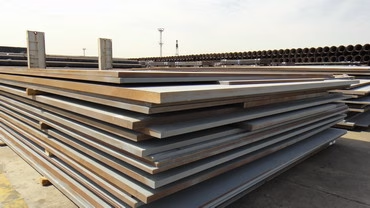
Medium and heavy steel plate is a primary mill product supplied in flat, rectangular form, characterized by its substantial thickness and used as the foundational material for structural fabrication and industrial component manufacturing.
Material
Carbon Steel, High-Strength Low-Alloy (HSLA) Steel. Representative grades include ASTM A36/A283 Gr. C/D, EN 10025-2 S235JR/S355JR, JIS G3101 SS400/SM400, GB/T 700 Q235B.
Model
Prime Plate, Structural Plate
Size
Widths from 1500 mm to 4500 mm; lengths from 6000 mm to 25000 mm, with cutting-to-length services available.
Thickness
6 mm to over 300 mm. “Medium Plate” typically refers to 6-40mm, while “Heavy Plate” refers to >40mm.
Standard
ASTM A36, A283, A572; EN 10025-2; JIS G3101, G3106; GB/T 700, GB/T 3274.
MOQ
15 Metric Tons.
Delivery Time
Standard lead time is 4 to 8 weeks for mill production; stock material can be delivered in 2-4 weeks.
Long Description
Medium and heavy steel plate refers to the product category of flat-rolled steel produced in discrete plate form, as opposed to coil, with a thickness typically ranging from 6 millimeters to over 300 millimeters. These plates are produced on reversing plate mills where slabs are progressively reduced in thickness through multiple passes at controlled temperatures. This product form serves as the essential raw material for a vast array of downstream industries, where it is cut, beveled, formed, and welded into final structures. The category encompasses a wide spectrum of steel grades, from general structural carbon steels (e.g., S235, A36) to specialized grades for pressure vessels, shipbuilding, and abrasion resistance. Its defining characteristics are its dimensional versatility, load-bearing capacity, and suitability for heavy welding and machining operations. Plates can be supplied in the as-rolled, normalized, or quenched and tempered condition depending on the required mechanical properties.
Key Product Highlights
This plate product form is the primary choice for fabricating large, load-bearing structural members and industrial bases.
It is available in an exceptionally wide range of thicknesses, widths, and lengths to meet diverse project specifications.
Plates can be sourced in various steel grades and delivery conditions to match specific mechanical and environmental requirements.
The product offers excellent suitability for a wide range of fabrication processes, including cutting, welding, drilling, and machining.
As a prime mill product, it provides full material traceability and certification to international standards.
Product Advantages
Direct supply from plate mills ensures material integrity, consistent quality, and reliable dimensional tolerances.
The product’s versatility allows it to serve as a single-source material for diverse components within a large project.
Technical support includes certification for chemical composition, mechanical properties, and optional non-destructive testing.
Established logistics networks facilitate the delivery of oversized and heavy plates to fabrication sites worldwide.
Available from stock in common grades and sizes for immediate procurement, alongside mill production for custom orders.
Industry Application
This plate is used in the construction of building frames, industrial plant structures, machine bases, ship hulls and decks, storage tanks, bridge components, platform grating, and as feedstock for large-diameter welded pipe.
Technical Specifications
| Parameter | Unit | Medium Plate (e.g., 20mm Thick) | Heavy Plate (e.g., 80mm Thick) | Notes |
|---|---|---|---|---|
| Carbon Content (C) | % | 0.17 max (S235JR) | 0.20 max (S355JR) | Varies significantly by specific grade ordered. |
| Manganese (Mn) | % | 1.40 max | 1.60 max | Varies by grade; higher for increased strength. |
| Phosphorus (P) | % | ≤ 0.045 | ≤ 0.045 | Maximum allowable for common structural grades. |
| Sulfur (S) | % | ≤ 0.045 | ≤ 0.045 | Maximum allowable for common structural grades. |
| Tensile Strength | MPa | 360 – 510 (S235) | 470 – 630 (S355) | Grade and thickness dependent range. |
| Yield Strength | MPa | ≥ 235 (S235JR, t≤16mm) | ≥ 355 (S355JR, t≤16mm) | Minimum ReH value; decreases with increasing thickness. |
| Elongation | % | ≥ 26 (S235JR) | ≥ 22 (S355JR) | Minimum longitudinal value, thickness dependent. |
| Hardness | HB | N/A | N/A | Not a standard specification for general structural plate. |
| Thickness | mm | 6 – 40 | >40 – 300+ | Industry classification between medium and heavy plate. |
| Width | mm | 1500 – 3500 | 2000 – 4500 | Heavy plate mills typically have greater width capacity. |
| Coil Weight | MT | N/A | N/A | This product is supplied as discrete plates, not in coil form. |
| Surface Treatment | – | As-Rolled (mill scale) | As-Rolled (mill scale), Blast Cleaned | Often supplied with mill scale; blast cleaning is optional. |
| Coating / Finish | – | As-Rolled (AR), Normalized (N) | As-Rolled (AR), Normalized (N) | Delivery condition depends on grade and property requirements. |
| Rolling Type | – | N/A | N/A | Parameter is specific to coil products; plates are milled. |
| Standard Example | – | EN 10025-2 S235JR | EN 10025-2 S355JR | Representative general structural steel grades. |
Packaging & Surface Treatment
Plates are bundled and secured on heavy-duty steel skids or in custom-built lifting frames. Wooden dunnage is placed between plates for protection and to allow lifting sling access. Bundles are tightly strapped with multiple steel bands. For export, they are often wrapped in waterproof plastic or coated paper. The standard surface condition is as-rolled with mill scale; plates can be supplied blast-cleaned and primed upon request for an additional charge.
Aliases Names
Structural Plate, Mill Plate, Prime Plate, Thick Plate, Flat Steel Plate, Plain Plate.